Friday, 13 May 2016

Woowee, a Brilliant Bird Passes By Me

Monday 9th May fresh ESE Sunny and warm 21C

Very early morning starts at Titchwell with a nuclear bomb-like sunrise; one where a small area of sky apears glowing red just before the bright orb peeks above the horizon.
Bitterns boom and birds can be added by song and call to the day list. I head off for Holme. Arriving at the golf course west of the NWT nature reserve, turtle doves are purring and give glimpses from dense cover. 239.
The wind has freshened and the branches bend in the breeze. I take the coastal path around the outside of the Holme reserve and find a very tiny small blue butterfly and a toad sits on the path rather prone. Other butterflies sheltering include small coppers and wall. Both common and lesser whitethroats are singing here too and a common toad sits on the path reluctant to move.


On the far side of Holme's reserves, I find a grasshopper warbler that goes from one clump of thick vegetation to the next and so on, giving brief glimpses.
The tide is very high and covers part of the car park at Thornham as well as covering all of the saltmarsh there.
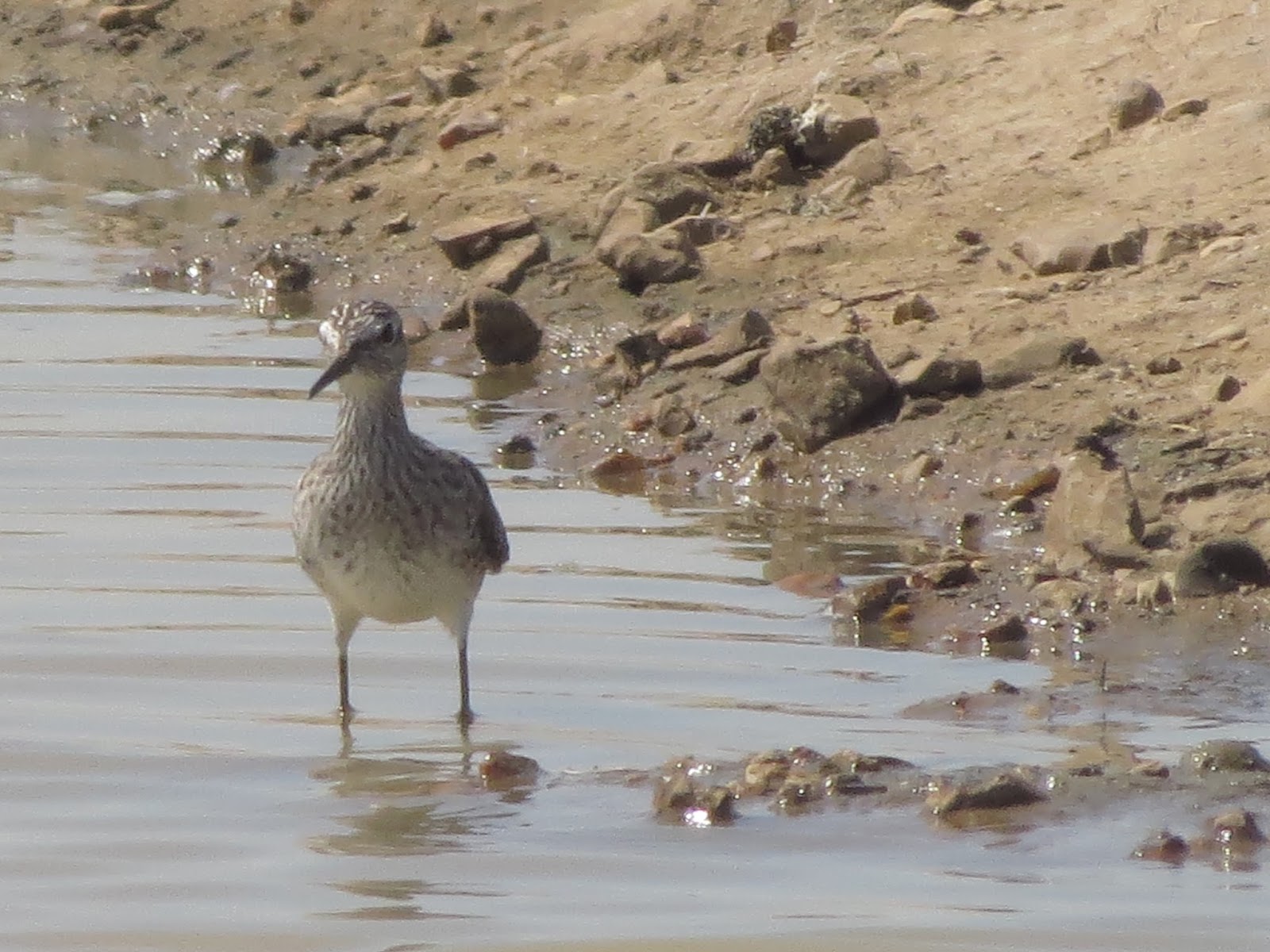
From here I decide to meander along North Norfolk's country lanes and hope for news of a rarity, or at least a year tick to come through. Dreams of finding one myself filter through and indeed almost happen as I come across a small flooded area of a winter wheat field. This time though I have already seen the bird I find but this one is so much closer and in such a strange spot. A wood sandpiper stands next to the puddle.

Cycling along towards Burnham Norton an even better bird has me leap off the bike and shout with delight; a male Montagu's harrier flies by and is gone in a minute or two. Superb new bird for the year, Montagu's harrier was one I was nervous about missing and here was one in front of me. Snatched photographs are poor but what the hell, they show the bird and the excitement.

Elated I continue along and take an inland route to Wells-next-the-Sea instead of following the coastal road. This takes me behind the extensive wooded grounds of Holkham Hall. It is great to have singing birds in hedgerows that grow tall and thick beside every road. Common whitethroats outnumber lesser whitethroats but both are in good numbers. Both of these outnumber yellowhammers.
On reaching Wells, I book into the Wells Youth Hostel. At £10 a night I can't complain and I am soon asleep. Truth be told I have been very ill for the last three weeks with probably a cold first off. This affected my asthma and filled my sinuses with painful rubbish. Today has been the first day without the feverish, sweaty feeling. The first day I feel I have this thing beat. Mind you my cycling gloves show that it has been a bit tough.


So the year list now stands at 240, 19 birds ahead of this time last year. Birds seen on this date and the day before last year included the citril finch and Moltoni's warbler.


30.23 miles 1006 feet up elevation 978 feet elevation down

Thursday, 12 May 2016

A Big Green Day

Sunday 8th May fresh ESE Sunny and warm 24C

Awake in my tent at an early hour I listen and hear woodlark and tree pipits singing. Getting out of my sleeping bag, getting dressed and wlking from the woodland to the heath I see woodlark and tree pipit; the latter is bird number 234.


I take my tent down and pack, making sure that my rhododendron surrounded clearing is clear of anything there before.
It is still before 6:00AM and I feel like a 'Big Day.' Coal tit, goldcrest and nuthatch before leaving Dersingham, Ihead for Snettisham. Last night's reason for heading this way, the alpine accentor at Gibraltar point, has flown and therefore Ithink I will head back to Titchwell via Holme. Can I get 100 birds today?

Arriving at Snettisham about an hour after the high tide mark, there are sill a good number of knot and oystercatchers at roost. It is around 8:30am and hot already. It is pleasant to shelter from the sun inside the bird screen. The closely packed knot hav a few more red, summer plumaged individuals than a few weeks ago yet most are still grey. There are two silent bird photographers in here. They have their lens focussed on the knot flock and ignore the action as a peregrine causes starling like murmurations of knot flocks over The Wash. They also ignore a rather humourous clash of two male black-headed gulls. A rogue male is trying to seduce another male's female. He hovers about a metre over the female as she keeps trying to peck him. Eventually the pair's male attacks the interloper and together they fight with beaks locked on the shingle. They roll around for a few minutes before disengaging and posturing.

Not a click from the cameras. Each to their own, I prefer the behavioural stories.
A text from The Oracle, bonelli's sp. Singing at Gibraltar Point. I set off. On reaching the main road the news is that the bird hasn't been either seen or heard again and so I decide to head for Hunstanton and Holme.
Walking along the cliff path at the former a pair of Mediterranean gulls fly past.
After lunch in the Norfolk Wildlife Trust, NWT, cafe an a chat with an ex-president of the NWT over farming subsidies and the Norfolk beef industry, I go through the Norfolk Ornitholical Association's bird observatory area and wave to the warden who is busy on the phone. Reaching the plank walkway along the sand dune ridge, I push and cycle to Thornham and onto Titchwell.
A birder calls me over. He has found a whinchat and wants to share it with me. Lucky me, another new bird to see for the year list. 235. Another birder shares his telescope a little further along the path so that I can see two wood sandpipers and add them to the year list too. 236.
A birder from Willenhall. Near to Wolverhampton one of my old home places, tells me that he has seen two spotted flycatchers nearby and soon enough we are watching them as they fly catch from perches in the willows. 237. Three new year ticks in quick succession, can't be bad.

The day list is seventy five and with Titchwell still to explore properly, the list climbs steadily. Brent geese are still her in good numbers and a greenshank has replaced the wood sandpipers. A short-eared owl quarters Thornham Marsh and is chased by a marsh harrier spectacularly.
Year listing isn't finished for the day yet as a grasshopper warbler reels and by climbing on a bench, I get a very brief view of it before it drops down into thick cover.

Red-crested pochard on Patsy's Pool takes the list to ninety-eight for the day and despite the sun having almost set I decide to cycle to nearby Choseley Barns to try for the final two birds that would take me to the magic 100.
The sun sets and the thinnest of crescent Moons is in the clear sky. The dotterels aren't on view but a male yellowhammer is singing and easy to see.
Ninety-nine.
All the partridge seem to be red-legged but using my camera as a telescope I can just make out a dark belly on a distant bird. Grey partridge, bird number 100 for the day. Brilliant.

So the year list now stands at 238, 29 birds ahead of this time last year.


30.4 miles 691 feet up elevation 801 feet elevation down

Monday, 9 May 2016

Back To Norfolk

Monday 9th May fresh ESE Sunny and warm 21C

An early morning start today, 4:30AM with not a cloud in the sky and a superb sunrise. The wind is fresher than yesterday making it cooler than the last few days.
Lots of news to catch up on. The year list is now on 239, 22 ahead of this time last year. I am now in the cafe at Titchwell RSPB reserve, North Norfolk, having cycled from Kent to here via the Lady Amherst's pheasant.

Let's go back a few days . . .

Tuesday 3rd May light NW sunny, warm

A cycle to Rainham RSPB reserve for lunch. I couldn't miss out one of my favourite RSPB reserves, could I? The cycle path along the Thames took me straight there and also took me away along the great river before I head inland for Dagenham.
A crash . . and my fault. I have sunglasses on for the first time this year and the traffic is stuck along a long road. I cn get through along the inside, just. Unfortunately to avoid a drain hole I swerve and hit aside mirror. I immediately stop and so meet Marcia. My fault, my cost. Sorry Marcia.
The cycling is rough due to going through the north-eastern edge of London. 

Reaching the Lea Valley reservoirs gives me a break from suburban roads and, after watching a fox strolling around a large horse field, a cycle path heads due north along the canalised river to some prism shaped lodges that make up a youth hostel.

Wednesday 4th May light SW getting hot! Sunny

Off early in the morning to get to the lady Amherst's pheasant location. This is the only one, a male, left in Britain so I need to see it. It will soon be gone.
A stop in Hatfield to see one of my very best friends was as wonderful as ever. Coffee and chat, catch up and deep friendship.
Arriving at the village graveyard, I push the bike up through it and out along a grassy footpath. Finding the pheasant's haunt, I peer into the scrub, searching for this amazing looking bird. It calls repeatedly; a three note call softer than the double note common pheasant. I don't see it and camp nearby.


Thursday 5th May light S sunny and hot 24C

Up early after listening to the Lady Amherst's coaxing me out of my sleeping bag. It proves almost impossible to see and yet doesn't seem to be moving around the dense undergrowth. Garden warbler and blackcap sing in bushes adjacent to the wood and a cuckoo flies over. Three more birders arrive to help with the search; Laurence and John from Cirencester, and Peter from Cornwall.
Around 8:00am I find it! Lady Amherst's pheasant onto the list as it shows in a less-than-a-metre area next to a tree trunk about forty yards in front of us. A photograph of this bird is a rare thing these days.

Bird secured I need to get to Norfolk.
The rest of the day is spent cycling to the Ouse washes RSPB reserve. Once there the evening is spent in the brilliant company of Steve, the RSPB farm stock coordinator there. Together we sit in the office and he tells me every tale of cows over the ages for about two hours.
As the sun goes down and darkness falls I hear and watch drumming snipe.

Friday 6th May fresh E very sunny and hot 24C

Early morning birding at Ouse Washes RSPB reserve, moving from hide to hide to view over the wet grassland and pools. There are a number of male garganey and I count five before reaching the visitor's centre for an early cup of tea with Steve.

A short-eared owl is a surprise for this time of year. Fifty species of bird before breakfast, always a good sign.
The oracle sends a text detailing a purple heron at Heacham. I set off but I am too tired, shattered by the recent cycling distances. I reach Welney WWT reserve and decide to stop for some lunch. News from Gill and Amanda bout a temminck's stint having just been found takes me to the hide where the bird can be seen. Bird number 230 and another good one to get. A great white egret pokes ot head out from behind some tall rushes behind it.


Back at the WWT cafe I just get some soup when Amanda comes up to me again to say two curlew sandpipers have been seen right at the far end of the reserve. We both walk there but the birds aren't on view.
Leaving Welney, after eating my soup eventually, wonderful carrot and coriander soup, I leave but can only cycle as far as Downham Market. A bed is available at the best value Bed & Breakfast in Norfolk and I am soon in bed. Only after having a relaxing bath though, and drinking a mug of hot chocolate. I am truly bushed!

Saturday 7th May fresh E sunny and very warm, 24C

After an immense breakfast I set off for North Norfolk. One last word on this Bed & Breakfast; in a county renowned for B and Bs being expensive, at £35 a night, Chestnut Villa is superb value for money. A lovely bedroom with ensuite, coffee, cup a soups, tea and hot chocolate, chocolate bars and milk. The bathroom has anti-antiperspirants, shampoos, creams and shower caps. June is a lovely host and so welcoming and helpful.
OK, advert over.
I soon reach the cycle path that takes me off the main road and allows me to sing along to Quadrophenia on the MP3 player.
Dotterel are today's target and to get to Choseley quicker I take the back roads after Sandringham. It is very hot and soon two litres of milk have been drunk.
Reaching the spot that dotterel seem to have made their migration resting stage, I join others and search the distant stubble fields for the special birds with a terrific heat haze making viewing almost impossible. Someone says they have one in their telescope and proffers the eyepiece for me to get a view. There is a bird in the centre of the view but there is no way I can say it is a dotterel. An eyestripe, a bit of breast and maybe a wing, all shimmering and indistinct. A view of a different,closer bird is better and so dotterel can go on the year list.


I cycle along the lane towards the famous barns and stop on the hill adjacent to the dotterel filled stubble. Here at last I get excellent views of four dotterel.
There are only three of us at this spot and I can't remember how or why but the discussion goes onto suppression. I mention to one gentleman, that a famous case of acting against suppressors was when an Essex birder claimed he had seem an extremely rare hermit thrush. He hadn't but was so fed up with certain Essex birders surpressing the news of rare birds that he made up that he had seen the very rare North American thrush.
That was me,” says the other gentleman in our trio.
Unbelievably it was too. Nigel Pepper, who in 1994 did such a birding 'crime'. He claim clean in Birdwatch magazine with a double page spread explaining his reasons. A hero for making a stand against suppression or a villain for carrying out the birding cardinal sin of a hoax? Take your pick but here is the man standing right here with me. Now what shall we talk about? I heard his explanation.
To Titchwell for the afternoon, a little gull there in the morning has moved on. Both temminck's and little stint are here.
I go to the beach an see a number of little terns, bird number 232. I return to the hide to find that a wood sandpiper has just flown over. Missed it.

I head for the reed bed where a grasshopper warbler was reeling this morning.

A text from The Oracle.... alpine accentor at Gibraltar Point nature reserve near to Skegness; about ninety miles away. With the sun setting I set off. 

Tuesday, 3 May 2016

A Mega Goes on the Year List. Clam on!

Saturday 30th April Light to fresh NW Sunny intervals with one prolonged heavy shower PM

A cycle to Lydd for more food with whitethroats singing from apparently every bramble patch. An almost unladen bike to ride, luxury.
To the RSPB reserve for the afternoon, the summer-plumaged black-necked grebe is now on the pool in front of the visitor's centre, more distant than yesterday's views.
Of interest along the pathway is the only colony of andrena vaga, a small bee in the UK. Concertinaed green tiger beetles are amusing; piggy back for four.


Into the visitor's centre just as a very heavy rain shower hits. I spend some time reading the history of the reserve display and marvel at the wooden slat shoes worn to aid walking over the shingle years ago. The name Bert Axell features large again with ideas used to assist the breeding birds; forty pairs of Kentish plovers! Dream on.

Outside swallows and sand martins perch on branches to rest during the rain.

Sunday 1st May light SW sunny, warm!

Today is all about distance. A rufous turtle dove has been reported just north of Sevenoaks and I need to see it. I set off early and appreciate not only the lack of wind and the sunshine but also the flat road for the first fifteen miles. Yellow wagtails are along the roadside just north of the RSPB reserve entrance.

Mile after mile, the ride is not strenuous and with two litres of milk and a litre of blackcurrant juice, I have plenty to drink along the way. I stick to a one hour drink, one hour food regime; maltloaf and jam sandwiches for the food.

A cruel reminder of my football team's fate is seen as I cycle through Tenterden. How different a prospect for the Villa to that of Leicester City yet I was there when it was the other way round. Highbury, 1981; Aston villa lost 2 – 0 to arsenal yet still won the First division due to Ipswich losing at Middlesborough. Me, my brother Paul and Dad were at that match. Wait a minute, I must watch the highlights on youtube.


Enjoyed that. A few tears. Fourteen players used all season and it got better the next year and yes, I was there for this one too.


Later back at Villa Park I even managed to drop the cup after being photographed holding it! A long time ago. Back to today.

Congratulations to Leicester City. The best thing that has happened in British football for a very long time.
Miles go by and eventually the benign, flattish roads take me to steeper sections. Whilst pushing up one particularly steep hill I come across a sleeping tiny fox cub. As I reach down for my camera it wakes up, notices me and disappears into the fox den. I think my chance has gone but another small cub waddles over and doesn't notice me. Wonderful moments of watching a beautiful little creature.

Further along the road I see another somewhat older fox cub take his life in his hands crossing a main road. It tries once and a car just misses it as it dives back into cover. Then moments later it tries again, luckily successfully.
I arrive at my destination, a place made obvious by the crowd of birders who are all looking at something in a nearby tree. I see one of my best Wolverhampton friends, a Birding Clam no less, Steve Allcott. He sees me and shouts for me to look quickly through his telescope. Rufous turtle dove goes onto the year list in moments as the bird is seen first with his glistening back to me. Then it turns around to make sure I see all sides.

Another crowd of birders are further down the road, closer to the bird and I go along to them leaving the bike against a wall. Another Birding Clam, Jason Oliver, is with them and together we laugh and celebrate such a rare bird. Other birding friends are there too; Jumbo and Pete who I had met on Fair Isle last year, Geoff and Carol from near Leicester, John Pringle from Essex. 

Birders come up to hear of the ride from Dungeness, fifty eight miles, almost exactly the same distance that I cycled last year for the citril finch at Holkham. Some kindly give donations for the charities. Brilliant.

The bird? Oh it flew off after twenty minutes or so to be seen much later. Being of the meena sub-species, this is a new bird for me. I saw the Chipping Norton orientalis bird in the pouring rain a few years ago and the hope is that the scientists will decide that these two are separate species one day.

76.80 miles 2869 feet elevation up 2787 feet elevation down


The Green Year list now stands at 226, still 27 birds ahead of this time last year.

Saturday, 30 April 2016

Saturday 30th April, Dungeness

Saturday 30th April

Early Saturday morning after a comfortable night in a bed for a change at the excellent Dungeness Bird Observatory. The sun is shining and there is a light northerly breeze; very different to yesterday's south westerly gale.
So a bit of time to catch up with the last few day's birding......

Tuesday 26th April

Still feeling very tired, I managed to cycle to Grove End and Stodmarsh nature reserve. I spend the day pushing the bike along the many paths with the hope of hearing a grasshopper warbler in the evening. There are occasional heavy showers and a cool north-westerly.


Common terns are over the largest pool and a few sedge and reed warblers are along the pathways.
The highlights of the day do occur in the evening when a hobby, 221, flies past and a hen harrier, ring-tail, comes down to roost in the reed bed.

Wednesday 27th April

A cycle down to Dungeness is relatively straight forward. Arriving at the RSPB reserve in mid afternoon, I spend the time searching Denge Marsh for the bean goose reported to be there on the previous day. A dip. Can't find it.

Thursday 28th April

With the wind only alight westerly early morning I head off for Pett Levels in East Sussex to look for two velvet scoter reported there.
A flock of thirty-plus whimbrel and very obliging yellow wagtails delay me at scotney Gravel Pits on the way to Rye.


Taking the Rye Harbour roadway I soon reach Pett and with the help of Steve, a Kent birder who I had met at Grove End two days earlier, have velvet scoter to add to the year list, 222. The long present glossy ibis puts in an appearance too.
Back to Rye Harbour I take time to enjoy its birds as by now the westerly has freshened up and a lunch break there is rewarded with views of nesting Mediterranean gulls and sandwich terns.


Friday 29th April

Back at Dungeness, I head for the seawatching hides by the nuclear power station, seeing a ghostly barn owl and a couple of whimbrel on the way.
At 'The Patch' there are a good number of common terns, around 75. Once in the shelter of the hide, the birders present say that one arctic skua went past at about ten to 6 and a few manx shearwaters. It is now 6:30am and only common scoter are going past in any numbers and even they aren't too numerous.
Seawatch finished, I go to the Dungeness Bird Observatory and book in for the night. I love staying at observatories. One, they are so cheap! More importantly birders stay at them and therefore the evening conversation is guaranteed to be birdy. Dave Walker, the long-standing warden of the Obs, takes my money and I decide not to use the bike for the day, instead I will walk to Lydd to get some food and bird on the way there and back.
Into the willow bushes near to the observatory and an almost tailless fox stands on the path not thirty yards away and looks back at me with disinterest.

Bumblebees take my own interest and there seems to be two varieties out in the cold, hazy sunshine. Garden and red-tailed.
Lesser and common whitethroats are vocal and on reaching the ARC pit a superb summer-plumaged black-necked grebe is sheltering from the fresh westerly breeze.

In fact the wind is gathering strength and after looking around the Cathedral in the Marsh, All Saints in Lydd; where a poem from the First World war is accompanied by two original WW1 crosses, it is strong and cold.


Back to Dungeness RSPB reserve via the back bridleway, only greylags and Canada geese are on Denge Marsh.
Back to seawatch the evening away, Andy, a birder who I had last met at Sumburgh Lighthouse last Autumn, immediately sees a distant passing bonxie, great skua and passes me his telescope to add it to the year list, 223.
Two manx shearwaters pass and the operation with Andy's 'scope is repeated; 224. Finally two arctic skuas pass, jokingly they seem closer to France than England! 225, onto the list due to the telescope of a birder from Norfolk, Matthew. What a fabulous evening.


The Green Year list now stands at 225, still 25 birds ahead of this time last year.

Details from 26th of April

Tuesday 26th April

It is now early on Tuesday morning and I am in Margate, Kent. After a day of rest yesterday it is time for me to get back on the bike and head for Dungeness forty five miles to the south west. A Bean goose has been there recently and pomarine skuas have gone past the headland.
The rest is due to the previous three days efforts, 168 miles from Minsmere to Margate, cycling. Why Margate? An Iberian chiff chaff in a local park had been seen and luckily, very luckily, I turn up there on Sunday evening and not only hear it but get close views of a chiff chaff with a funny, squeaky, repeated call. 

Bird number 220 onto the Green list and one I had not thought I would get.
So 85 to go in order to get the European record and around fifty 'regulars' still needed.

The Green Year list now stands at 220, still 27 birds ahead of this time last year.


59.76 miles 2022 feet elevation up 1998 elevation down 

Saturday, 23 April 2016

Good Morning to the World

Friday 22nd April fresh N Cloudy with occasional light rain. Cool 8C with cold wind.

Καλημέρα
God morgon
Доброго ранку
Magandang umaga
Goeie more
Bom Dia
Buna dimineata
Maidin mhaith

in other words . . .
Good Morning!

It is amazing to see on the blog where people who are following me come from. It is possible to see the countries and in the last week the above morning greeting represents the top ten countries. Thanks to you all and I hope that my pages may inspire you all to try Green Birding and do your bit to limit Climate Change/Global Warming. On that subject, it is so wonderful to see the commitment Leonardo di Caprio has to this as his latest donations show.

http://www.telesurtv.net/english/news/Leonardo-DiCaprio-Donates-3.4-Million-to-Ecuador-20160122-0006.html

The Oracle's text from the previous evening states that there are two black terns at Alton Water south of Ipswich; a bird that I have never managed to see whilst cycling so of major importance to add to the list. After fixing th back brake in the shelter of the South hide and after a chat with an early rising RSPB staff member, I set off south. Leaving Minsmere is strange after the last four days here. Each day has been different and I feel I know the reserve a lot better having explored every pathway. This could easily become my favourite RSPB reserve, so diverse and with such incredible biodiversity.
By 9:00am I am at Blaxhall youth hostel and having no word from Phil about the terns, I book in. Coffee and washing up, my phone receives two texts and I miss a phone call. The terns are still there! With apologies to Amy, the hostel manager, and reimbursed the overnight cost, I set off once more as the weather deteriorates and spitting rain falls.
Through Woodbridge and Ipswich, where I make the mistake of following the convoluted Route 1 Sustrans cycle path instead of the straight main road, I get, eventually, to Lemon's Hill bridge. A gentleman in a car calls my name. Chris Baines, a facebook friend who I had last seen whilst watching a bluethroat near The Hook on Blakeney Point four years ago, Calls me over and together we watch distant terns. A year tick, seven or more arctic terns are over the water and then I actually make a little leap into the air. 

A black tern comes into view. Brilliant. It is cold and raining slightly so photographs are appalling but both birds are on the list, 219. Black tern becomes the latest '16' bird, one that I didn't see last year. I need sixteen of these over and above the 289 I did see. Now maybe it is the cricket fan in me but I break the 16 down into 4 per quarter, that is four '16' birds per three month period. January to March gave me four : dusky warbler, Hudsonian whimbrel, glaucous gull and greater yellowlegs. April has given me two already, savi's warbler and now black tern. Things are looking good. Little targets to keep the spirits up and keep the legs pedalling.
Another pleasing thing from the bridge is the number of hirundines hunting flies low over the water. They are mostly swallows with some sand martins and the occasional house martin.
Saying goodbye to Chris, as I am now starting to shiver, I head off along the circumnavigating the lake cycle path. A helicopter comes low and lands in a garden backing onto the path.
Three miles later I am warming up with a large hot chocolate and enjoying the company of Gina and Andrew, the owners of the cafe at the south end of the lake. Mentioning the helicopter I am told it belongs to a city banker.
The only other customer in the cafe is Doreen, a local originally from Anfield, Liverpool. The four of us chat awhile before all too soon it is closing time and I carry on to search the lake for other birds. Three little gulls were reported this morning but they have moved on.

The Green Year list now stands at 219, still 30 birds ahead of this time last year.


50.69 miles 1473 feet elevation up 1443 elevation down       

Biking Birder in Rwanda 2025, Rugezi Ornithology Center Interview No. 2 Irakoze Roger

  Another interview video from my Biking Birder adventure from 2025, this one features Irakoze Roger. The Rugezi Ornithology Center is based...