Thursday, 19 May 2016

Summary Time 13th to 18th May - Six New Birds.

Friday 13th to 18th May

Friday the thirteenth. Fresh to strong NW Sun, increasing cloud, cold to very cold with wind chill.

I set off for Frampton with the news that a broad-billed sandpiper is now there with curlew sandpiper and a wryneck. T-shirt weather soon changes as clouds gather and the pleasant side on wind that takes me to King's Lynn becomes a strong and extremely cold gale.
A stop for some chips and a fish cake, I live it up by having some lunch on a picnic bench at Sutton Bridge. The cycling is tough but the three available year ticks keep me going.
The A17 is as busy as ever and I avoid it as much as I can. It would be lethal to cycle it in this howler. 

Cycling along one small back road stretch I see a stoat some out of the grass in front of me. I stop and it passes right past my feet!

Eventually I reach Frampton and quickly head to the spot where the broad-billed sandpiper has been seen; a small group of birders marks the spot.
It has gone, flown off with a flock of dunlin. There is a curlew sandpiper, bird number 242.
“It will be back,” I am told.
Late evening, the bird hasn't returned and looks like it has gone. A temminck's and three little stint, as well as three curlew sandpiper and a lack of the wryneck, also gone, make for mixed feelings.

67.40 miles 1289 feet up elevation 1319 feet down elevation

Saturday 14th May Fresh NW Sunny intervals, not so cold.

A friend from the Midlands appears, Rob Wardle, and together we walk to the spot where the broad-billed sandpiper was last seen. Dunlin and ringed plover, a text jingle and a message from T Oracle. 'the sandpiper is on site.' I look across to a small group of birders adjacent to the car park and notice one waving to us frantically, beckoning to us to come on down!

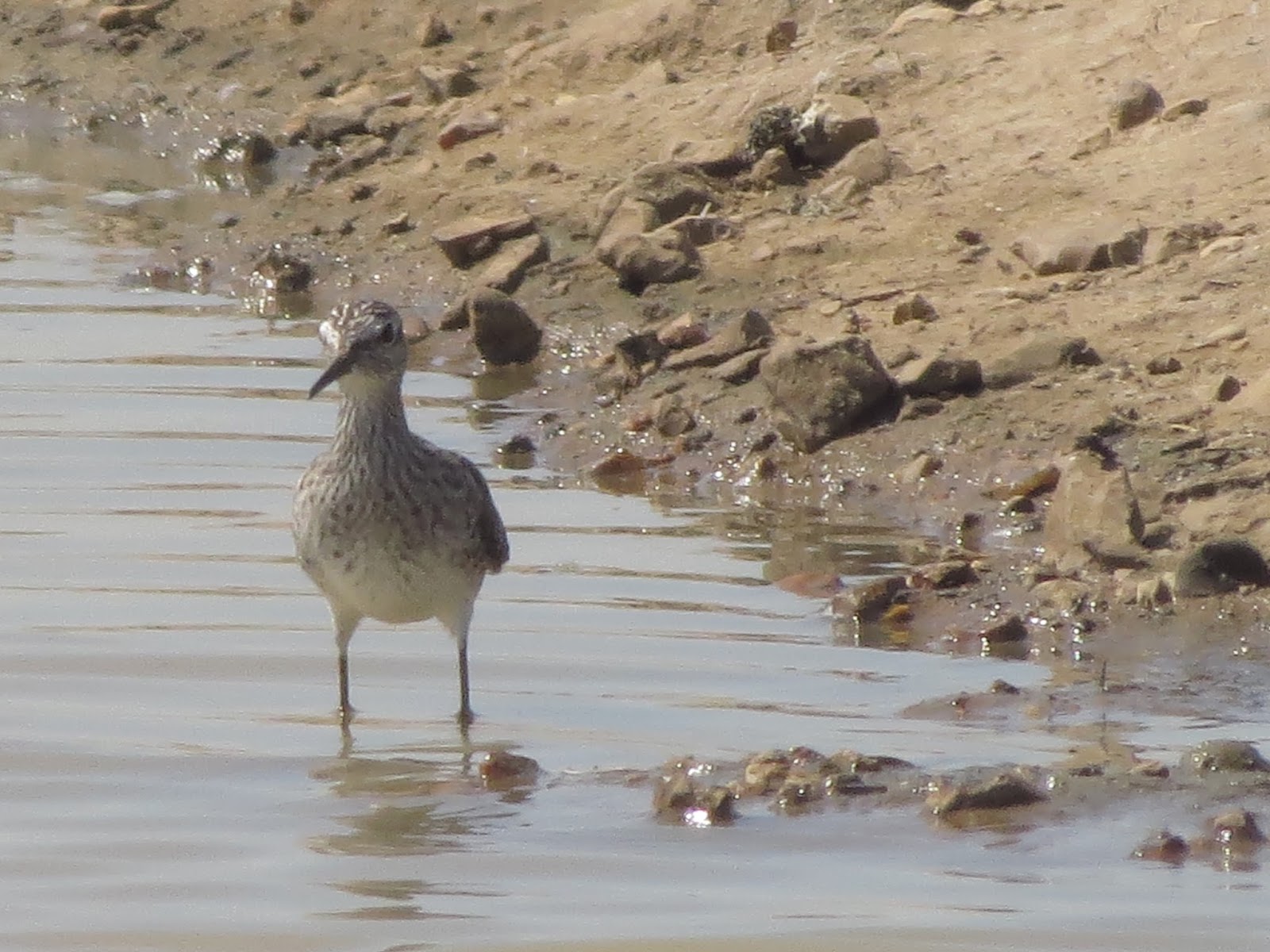
Broad-billed sandpiper is a close bird, greyer than the dunlin that surround it with zebra head and obvious large drooping bill. Brilliant, a bird I haven't seen before whilst on a Green journey and my third ever.
With the bird UTB I have another go at searching for the wryneck and collect two carrier bags full of strandline plastic. This all goes to be recycled but my efforts aren't rewarded by the wryneck turning up.
I set off for Abberton reservoir in Essex. There is a Franklin's gull, an American bird that has been showing up there for a few days.
With the wind behind me at last the cycle is pleasant and reasonably fast. Through Holbeach and Wisbech, I reach the village of Three Holes and a text; two white-winged black terns at March farmers. I turn to the west and head that way.
Evening time, white-winged black tern goes onto the list despite being quite distant on the far side of the flooded meadows. Thanks to Nigel and Amanda from Deeping for the use of their telescope. Two short-eared owls are closer and there are a number of black terns out over the water also. One of the editors of Birdwatch magazine is there so who knows maybe my exploits will grace the magazine's pages. More importantly it would be fabulous to see an article on Green Birding in there.
With two more birds of superb quity added to the year list I cycle on.

69.49 miles 440 feet up elevation 423 feet down elevation

Sunday 15th May light W Sunny, cool to warm

Another target bird has appeared, a great reed warbler at Paxton Pits and I detour in that direction.
Just south of Huntingdon my mobile tells me there is a cycle path but it is a bumpy, grassy mountain bike only affair that goes along the beautiful river Ouse. It is lovely and I would love to push the bike along this stretch and enjoy the pastoral scenes but there is a rare bird to see and I return to the main road.
Paxton Pits, birders looking through gaps in the hawthorns to look over to a patch of reeds. The bird is singing away almost none stop but getting a view takes over an hour. A brief flight view and trembling reeds to show where it has landed are all I see. 

Then suddenly the great reed warbler climbs a reed to near the top and so having seen it, kissed it, licked it and ticked it, another very rare bird goes onto the year list. 245.

53.17 miles 1010 feet up elevation 968 feet down elevation

Monday 16th May light W sunny, warm

Cycling along the country lanes south of Cambridge, corn buntings and yellow wagtails are seen.
Something is up with the bike, a puncture, the first of the year and the first since last June in fact so I can't complain. It is the front tyre and it takes me thirty one minutes to repair and replace.
Still the bike feels sluggish but I put it down to feeling very tired after cycling 180 miles in the last three days. Along one narrow lane and whilst cycling uphill a car comes behind me and seems reluctant to overtake. I feel irritated as I get off to let it past and feel embarrassed when the lady driving, Monica, calls me over to give a donation. She has seen the RSPB sign on the back of the bike and wants to give to them. There are lovely people out there and I shouldn't let my tiredness make me grouchy.
I reach Abberton in the late afternoon after negotiating an excruciating and convoluted maze of small lanes. Two birders from Minsmere, both RSPB staff have been here all day but haven't seen the Franklin's.
Two other birders arrive and after an hour or so one calls out that he has got it. It doesn't inspire confidence when I look through his telescope and find a little gull, not the Franklin's that he is claiming. Still it is another bird for the year list, a first summer bird almost lost amongst black-headed gulls and common terns and distant in the heat haze.

Another hour of searching passes and the same birder shouts that he has got it. His friend and I don't get onto it. They go onto a bird identification app to check and I hear, “yep, that was it.”
They leave satisfied that they have seen the rare gull.
Alone for a while, I see a hobby and a couple of yellow wagtails. Then a birder arrives, Geoff Keen from Weybridge, and together we search.
The gulls have started to fly catch in the fading light with the sun almost setting. One gull catches my eyes and I scream, “There it is!” and there it is, thirty yards in front of us flying past. Partial dark hood, dark, long wings, black bill, this is the real thing and my extremely hastily taken photograph in the gloom does it no justice. 

Franklin's gull goes on the year list, unbelievably but so good. 247.

51.05 miles 1860 feet up elevation 1890 feet down elevation

Tuesday 17th May fresh SW sunshine to cloudy, cool 15C

The bike is still sluggish, especially up hills and I stop to check it out. I find that a spring on a front brake block has stopped retrcting the block from the wheel rim; repairs take a while. I have no battery left on my mobile phone and decide to get to Malden to charge it at the local library. With no news available I am cycling towards a bird, a red=footed falcon, that might not be there.
I spend two hours in the library, charging the phone and updating the news on facebook, checking emails and the like.
I reach Vange RSPB reserve, south of Basildon at around 3:00pm. The falcon hasn't been seen since one.
By dusk it hasn't returned and with the weather now cold and breezy, it seems as though it isn't likely to either. A dip and I luckily haven't suffered too many of those this year.

One pleasant thing, as per usual is the company of other birders. One in particular stands out, Tom Bell, a very enthusiastic young man who's patch is Rainham Marshes RSPB reserve. He delights in talking about the birds he has seen and the places he is about to go birding to. Minsmere and Skomer, very good; Alaska and California, brilliant.


The year list is 247, twenty four ahead of this time last year.

Time to head north, back to North Norfolk for an appearance at the excellent Norfolk Bird Fair this weekend. Hope to see you there.


http://www.norfolkbirdfair.com/    

Last six days cycling:-


320 miles 7283 feet up elevation 7128 feet down elevation

Sunday, 15 May 2016

A Day of Potential Unrealised

Thursday 12th May fresh NE Sunny 12C

I should head off for Frampton RSPB reserve in Lincolnshire. There is a wryneck there and curlew sandpiper. I don't. Instead I steadily bird Titchwell starting with a scan of the freshwater lagoon. 

There is a gorgeous male garganey out in the middle and a lone wood sandpiper on one of the islands. Both are soon gone though.
I walk to and then along alone on the immense beach that takes me to Thornham Point. I photograph items of interest on the beach and marvel at the millions of washed up razor shells. 

Along the tideline there are also mats of bryozoa and the occasional sea urchin and piddock. It's the razor shells though that are sometimes packed in deep drifts and I enjoy crunching them as I walk along. Helping make the sand on the beach, I think, as I always do when I walk along a beach, that there are more stars in the universe than there are grains of sand on every beach and in every desert in the World. A constant reminder to me of the immensity of our incredible universe.


The tick thorny bushes alongside the leaning ruin of a World War Two lookout tower look as though they should hold a migrant. They do but not the hoped for icterine warbler or white-spotted bluethroat. A chiff chaff is the only bird apart from a couple of dunnocks and a wren.
A cuckoo comes close being chased by a couple of angry meadow pipits.
Back at Titchwell I meet Trevor Girling again, the superb Norfolk birder and news comes in that a bee-eater has been seen and heard over Cley and is heading west. I position myself on the west wall walk and scan hopefully.
A Pallid swift is seen twice over Blakeney Marsh and is heading this way. I scan over the reedbed and watch every swift carefully.
Three hours later and after having joined Trevor on the meadow trail broadwalk we have to admit that neither bird has come our way.
Trevor leaves and I walk off towards Patsy's Pool. I stop for a while under the willow bushes to watch a passing group of nine baby long-tailed tits being fed by two workaholic parents. A birder excitedly runs up to me. “Did you see it?” An osprey had just flown over and has disappeared in the mist heading east.

The year list is still 241, exactly twenty ahead of this time last year.


15.93 miles 345 feet up elevation 333 feet down elevation

A Day of Rain and A Day with a Shrike

Tuesday 10th May fresh ESE Heavy rain

It is raining lightly as I cycle towards Cley but by the time I reach the famous Norfolk Wildlife Trust reserve it is bucketing down. With newspaper and laptop I relax in Daulkes hide and watch the wader antics. I fall asleep after lunch.

The rain doesn't stop until evening yet I am not tempted to walk Blakeney Point. I will leave that until the morning.

Wednesday 11th May fresh ESE Sunny intervals, 16C

A dilemma presents itself this morning. Do I walk and bird Blakeney Point , that tpioca pudding shingle walk of hell, or wait for news and bird Cley?
Everything about the weather says that there should be birds on the point yet I tarry (procrastinate?) and start the day list with common waders.
Red-backed shrike at Burnham Overy dunes, just beyond the west end of Holkham Pines!
I peddle as fast as I can and get there.

12:45 red-backed shrike UTB, bird number 241 and I watch it for the next hour or so mostly by myself. The shrike keeps disappearing into bramble and hawthorn and occasionally turns up some distance from its last location. The best views though re when I am sat on a small sand dune, tucked in from the cool breeze, and the bird hunts from a nearby barbed wire fence.
Throughout the hour view I meet four other birders, one of whom, Paul supports Aston Villa. We cry together whilst watching the shrike. 

I remember a scene from the comedic birdwatching film The Big Year with the Steve Martin's character being likened to a shrike. Randy Lerner, the current Aston Villa chairman and owner is a similar beast. In fact this analogy would be an insult to a shrike. I recommend any birder watching the film. I don't recommend supporting the Villa!
I search the dunes but cannot find any other birds of note amongst them and the pines. Mediterranean gulls are out over the marsh and a pair of stonechats along the marsh edge.
I head off for Titchwell, little gull reported there again and this is fast becoming a bogey bird. Seen in the morning, they have moved on by the afternoon.
Reaching Titchwell the little gull has moved on. I spend the afternoon walking around the reserve and meet Martin from Topshill nature reserve where I had been early April. Paul Fisher joins us and it is fabulous to spend time with such great people.

The evening I spend sitting in the Parrinder hide watching as curlew come into roost. Highlight birds amongst the day list of sixty nine include two teminck's stints and also a little stint, a whimbrel, bittern booming and a fly over spoonbill heading east.

The year list is 241, exactly twenty ahead of this time last year.

19.04 miles 440 feet up elevation 430 feet down elevation

Friday, 13 May 2016

Woowee, a Brilliant Bird Passes By Me

Monday 9th May fresh ESE Sunny and warm 21C

Very early morning starts at Titchwell with a nuclear bomb-like sunrise; one where a small area of sky apears glowing red just before the bright orb peeks above the horizon.
Bitterns boom and birds can be added by song and call to the day list. I head off for Holme. Arriving at the golf course west of the NWT nature reserve, turtle doves are purring and give glimpses from dense cover. 239.
The wind has freshened and the branches bend in the breeze. I take the coastal path around the outside of the Holme reserve and find a very tiny small blue butterfly and a toad sits on the path rather prone. Other butterflies sheltering include small coppers and wall. Both common and lesser whitethroats are singing here too and a common toad sits on the path reluctant to move.


On the far side of Holme's reserves, I find a grasshopper warbler that goes from one clump of thick vegetation to the next and so on, giving brief glimpses.
The tide is very high and covers part of the car park at Thornham as well as covering all of the saltmarsh there.
From here I decide to meander along North Norfolk's country lanes and hope for news of a rarity, or at least a year tick to come through. Dreams of finding one myself filter through and indeed almost happen as I come across a small flooded area of a winter wheat field. This time though I have already seen the bird I find but this one is so much closer and in such a strange spot. A wood sandpiper stands next to the puddle.

Cycling along towards Burnham Norton an even better bird has me leap off the bike and shout with delight; a male Montagu's harrier flies by and is gone in a minute or two. Superb new bird for the year, Montagu's harrier was one I was nervous about missing and here was one in front of me. Snatched photographs are poor but what the hell, they show the bird and the excitement.

Elated I continue along and take an inland route to Wells-next-the-Sea instead of following the coastal road. This takes me behind the extensive wooded grounds of Holkham Hall. It is great to have singing birds in hedgerows that grow tall and thick beside every road. Common whitethroats outnumber lesser whitethroats but both are in good numbers. Both of these outnumber yellowhammers.
On reaching Wells, I book into the Wells Youth Hostel. At £10 a night I can't complain and I am soon asleep. Truth be told I have been very ill for the last three weeks with probably a cold first off. This affected my asthma and filled my sinuses with painful rubbish. Today has been the first day without the feverish, sweaty feeling. The first day I feel I have this thing beat. Mind you my cycling gloves show that it has been a bit tough.


So the year list now stands at 240, 19 birds ahead of this time last year. Birds seen on this date and the day before last year included the citril finch and Moltoni's warbler.


30.23 miles 1006 feet up elevation 978 feet elevation down

Thursday, 12 May 2016

A Big Green Day

Sunday 8th May fresh ESE Sunny and warm 24C

Awake in my tent at an early hour I listen and hear woodlark and tree pipits singing. Getting out of my sleeping bag, getting dressed and wlking from the woodland to the heath I see woodlark and tree pipit; the latter is bird number 234.


I take my tent down and pack, making sure that my rhododendron surrounded clearing is clear of anything there before.
It is still before 6:00AM and I feel like a 'Big Day.' Coal tit, goldcrest and nuthatch before leaving Dersingham, Ihead for Snettisham. Last night's reason for heading this way, the alpine accentor at Gibraltar point, has flown and therefore Ithink I will head back to Titchwell via Holme. Can I get 100 birds today?

Arriving at Snettisham about an hour after the high tide mark, there are sill a good number of knot and oystercatchers at roost. It is around 8:30am and hot already. It is pleasant to shelter from the sun inside the bird screen. The closely packed knot hav a few more red, summer plumaged individuals than a few weeks ago yet most are still grey. There are two silent bird photographers in here. They have their lens focussed on the knot flock and ignore the action as a peregrine causes starling like murmurations of knot flocks over The Wash. They also ignore a rather humourous clash of two male black-headed gulls. A rogue male is trying to seduce another male's female. He hovers about a metre over the female as she keeps trying to peck him. Eventually the pair's male attacks the interloper and together they fight with beaks locked on the shingle. They roll around for a few minutes before disengaging and posturing.

Not a click from the cameras. Each to their own, I prefer the behavioural stories.
A text from The Oracle, bonelli's sp. Singing at Gibraltar Point. I set off. On reaching the main road the news is that the bird hasn't been either seen or heard again and so I decide to head for Hunstanton and Holme.
Walking along the cliff path at the former a pair of Mediterranean gulls fly past.
After lunch in the Norfolk Wildlife Trust, NWT, cafe an a chat with an ex-president of the NWT over farming subsidies and the Norfolk beef industry, I go through the Norfolk Ornitholical Association's bird observatory area and wave to the warden who is busy on the phone. Reaching the plank walkway along the sand dune ridge, I push and cycle to Thornham and onto Titchwell.
A birder calls me over. He has found a whinchat and wants to share it with me. Lucky me, another new bird to see for the year list. 235. Another birder shares his telescope a little further along the path so that I can see two wood sandpipers and add them to the year list too. 236.
A birder from Willenhall. Near to Wolverhampton one of my old home places, tells me that he has seen two spotted flycatchers nearby and soon enough we are watching them as they fly catch from perches in the willows. 237. Three new year ticks in quick succession, can't be bad.

The day list is seventy five and with Titchwell still to explore properly, the list climbs steadily. Brent geese are still her in good numbers and a greenshank has replaced the wood sandpipers. A short-eared owl quarters Thornham Marsh and is chased by a marsh harrier spectacularly.
Year listing isn't finished for the day yet as a grasshopper warbler reels and by climbing on a bench, I get a very brief view of it before it drops down into thick cover.

Red-crested pochard on Patsy's Pool takes the list to ninety-eight for the day and despite the sun having almost set I decide to cycle to nearby Choseley Barns to try for the final two birds that would take me to the magic 100.
The sun sets and the thinnest of crescent Moons is in the clear sky. The dotterels aren't on view but a male yellowhammer is singing and easy to see.
Ninety-nine.
All the partridge seem to be red-legged but using my camera as a telescope I can just make out a dark belly on a distant bird. Grey partridge, bird number 100 for the day. Brilliant.

So the year list now stands at 238, 29 birds ahead of this time last year.


30.4 miles 691 feet up elevation 801 feet elevation down

Monday, 9 May 2016

Back To Norfolk

Monday 9th May fresh ESE Sunny and warm 21C

An early morning start today, 4:30AM with not a cloud in the sky and a superb sunrise. The wind is fresher than yesterday making it cooler than the last few days.
Lots of news to catch up on. The year list is now on 239, 22 ahead of this time last year. I am now in the cafe at Titchwell RSPB reserve, North Norfolk, having cycled from Kent to here via the Lady Amherst's pheasant.

Let's go back a few days . . .

Tuesday 3rd May light NW sunny, warm

A cycle to Rainham RSPB reserve for lunch. I couldn't miss out one of my favourite RSPB reserves, could I? The cycle path along the Thames took me straight there and also took me away along the great river before I head inland for Dagenham.
A crash . . and my fault. I have sunglasses on for the first time this year and the traffic is stuck along a long road. I cn get through along the inside, just. Unfortunately to avoid a drain hole I swerve and hit aside mirror. I immediately stop and so meet Marcia. My fault, my cost. Sorry Marcia.
The cycling is rough due to going through the north-eastern edge of London. 

Reaching the Lea Valley reservoirs gives me a break from suburban roads and, after watching a fox strolling around a large horse field, a cycle path heads due north along the canalised river to some prism shaped lodges that make up a youth hostel.

Wednesday 4th May light SW getting hot! Sunny

Off early in the morning to get to the lady Amherst's pheasant location. This is the only one, a male, left in Britain so I need to see it. It will soon be gone.
A stop in Hatfield to see one of my very best friends was as wonderful as ever. Coffee and chat, catch up and deep friendship.
Arriving at the village graveyard, I push the bike up through it and out along a grassy footpath. Finding the pheasant's haunt, I peer into the scrub, searching for this amazing looking bird. It calls repeatedly; a three note call softer than the double note common pheasant. I don't see it and camp nearby.


Thursday 5th May light S sunny and hot 24C

Up early after listening to the Lady Amherst's coaxing me out of my sleeping bag. It proves almost impossible to see and yet doesn't seem to be moving around the dense undergrowth. Garden warbler and blackcap sing in bushes adjacent to the wood and a cuckoo flies over. Three more birders arrive to help with the search; Laurence and John from Cirencester, and Peter from Cornwall.
Around 8:00am I find it! Lady Amherst's pheasant onto the list as it shows in a less-than-a-metre area next to a tree trunk about forty yards in front of us. A photograph of this bird is a rare thing these days.

Bird secured I need to get to Norfolk.
The rest of the day is spent cycling to the Ouse washes RSPB reserve. Once there the evening is spent in the brilliant company of Steve, the RSPB farm stock coordinator there. Together we sit in the office and he tells me every tale of cows over the ages for about two hours.
As the sun goes down and darkness falls I hear and watch drumming snipe.

Friday 6th May fresh E very sunny and hot 24C

Early morning birding at Ouse Washes RSPB reserve, moving from hide to hide to view over the wet grassland and pools. There are a number of male garganey and I count five before reaching the visitor's centre for an early cup of tea with Steve.

A short-eared owl is a surprise for this time of year. Fifty species of bird before breakfast, always a good sign.
The oracle sends a text detailing a purple heron at Heacham. I set off but I am too tired, shattered by the recent cycling distances. I reach Welney WWT reserve and decide to stop for some lunch. News from Gill and Amanda bout a temminck's stint having just been found takes me to the hide where the bird can be seen. Bird number 230 and another good one to get. A great white egret pokes ot head out from behind some tall rushes behind it.


Back at the WWT cafe I just get some soup when Amanda comes up to me again to say two curlew sandpipers have been seen right at the far end of the reserve. We both walk there but the birds aren't on view.
Leaving Welney, after eating my soup eventually, wonderful carrot and coriander soup, I leave but can only cycle as far as Downham Market. A bed is available at the best value Bed & Breakfast in Norfolk and I am soon in bed. Only after having a relaxing bath though, and drinking a mug of hot chocolate. I am truly bushed!

Saturday 7th May fresh E sunny and very warm, 24C

After an immense breakfast I set off for North Norfolk. One last word on this Bed & Breakfast; in a county renowned for B and Bs being expensive, at £35 a night, Chestnut Villa is superb value for money. A lovely bedroom with ensuite, coffee, cup a soups, tea and hot chocolate, chocolate bars and milk. The bathroom has anti-antiperspirants, shampoos, creams and shower caps. June is a lovely host and so welcoming and helpful.
OK, advert over.
I soon reach the cycle path that takes me off the main road and allows me to sing along to Quadrophenia on the MP3 player.
Dotterel are today's target and to get to Choseley quicker I take the back roads after Sandringham. It is very hot and soon two litres of milk have been drunk.
Reaching the spot that dotterel seem to have made their migration resting stage, I join others and search the distant stubble fields for the special birds with a terrific heat haze making viewing almost impossible. Someone says they have one in their telescope and proffers the eyepiece for me to get a view. There is a bird in the centre of the view but there is no way I can say it is a dotterel. An eyestripe, a bit of breast and maybe a wing, all shimmering and indistinct. A view of a different,closer bird is better and so dotterel can go on the year list.


I cycle along the lane towards the famous barns and stop on the hill adjacent to the dotterel filled stubble. Here at last I get excellent views of four dotterel.
There are only three of us at this spot and I can't remember how or why but the discussion goes onto suppression. I mention to one gentleman, that a famous case of acting against suppressors was when an Essex birder claimed he had seem an extremely rare hermit thrush. He hadn't but was so fed up with certain Essex birders surpressing the news of rare birds that he made up that he had seen the very rare North American thrush.
“That was me,” says the other gentleman in our trio.
Unbelievably it was too. Nigel Pepper, who in 1994 did such a birding 'crime'. He claim clean in Birdwatch magazine with a double page spread explaining his reasons. A hero for making a stand against suppression or a villain for carrying out the birding cardinal sin of a hoax? Take your pick but here is the man standing right here with me. Now what shall we talk about? I heard his explanation.
To Titchwell for the afternoon, a little gull there in the morning has moved on. Both temminck's and little stint are here.
I go to the beach an see a number of little terns, bird number 232. I return to the hide to find that a wood sandpiper has just flown over. Missed it.

I head for the reed bed where a grasshopper warbler was reeling this morning.

A text from The Oracle.... alpine accentor at Gibraltar Point nature reserve near to Skegness; about ninety miles away. With the sun setting I set off. 

Tuesday, 3 May 2016

A Mega Goes on the Year List. Clam on!

Saturday 30th April Light to fresh NW Sunny intervals with one prolonged heavy shower PM

A cycle to Lydd for more food with whitethroats singing from apparently every bramble patch. An almost unladen bike to ride, luxury.
To the RSPB reserve for the afternoon, the summer-plumaged black-necked grebe is now on the pool in front of the visitor's centre, more distant than yesterday's views.
Of interest along the pathway is the only colony of andrena vaga, a small bee in the UK. Concertinaed green tiger beetles are amusing; piggy back for four.


Into the visitor's centre just as a very heavy rain shower hits. I spend some time reading the history of the reserve display and marvel at the wooden slat shoes worn to aid walking over the shingle years ago. The name Bert Axell features large again with ideas used to assist the breeding birds; forty pairs of Kentish plovers! Dream on.

Outside swallows and sand martins perch on branches to rest during the rain.

Sunday 1st May light SW sunny, warm!

Today is all about distance. A rufous turtle dove has been reported just north of Sevenoaks and I need to see it. I set off early and appreciate not only the lack of wind and the sunshine but also the flat road for the first fifteen miles. Yellow wagtails are along the roadside just north of the RSPB reserve entrance.

Mile after mile, the ride is not strenuous and with two litres of milk and a litre of blackcurrant juice, I have plenty to drink along the way. I stick to a one hour drink, one hour food regime; maltloaf and jam sandwiches for the food.

A cruel reminder of my football team's fate is seen as I cycle through Tenterden. How different a prospect for the Villa to that of Leicester City yet I was there when it was the other way round. Highbury, 1981; Aston villa lost 2 – 0 to arsenal yet still won the First division due to Ipswich losing at Middlesborough. Me, my brother Paul and Dad were at that match. Wait a minute, I must watch the highlights on youtube.


Enjoyed that. A few tears. Fourteen players used all season and it got better the next year and yes, I was there for this one too.


Later back at Villa Park I even managed to drop the cup after being photographed holding it! A long time ago. Back to today.

Congratulations to Leicester City. The best thing that has happened in British football for a very long time.
Miles go by and eventually the benign, flattish roads take me to steeper sections. Whilst pushing up one particularly steep hill I come across a sleeping tiny fox cub. As I reach down for my camera it wakes up, notices me and disappears into the fox den. I think my chance has gone but another small cub waddles over and doesn't notice me. Wonderful moments of watching a beautiful little creature.

Further along the road I see another somewhat older fox cub take his life in his hands crossing a main road. It tries once and a car just misses it as it dives back into cover. Then moments later it tries again, luckily successfully.
I arrive at my destination, a place made obvious by the crowd of birders who are all looking at something in a nearby tree. I see one of my best Wolverhampton friends, a Birding Clam no less, Steve Allcott. He sees me and shouts for me to look quickly through his telescope. Rufous turtle dove goes onto the year list in moments as the bird is seen first with his glistening back to me. Then it turns around to make sure I see all sides.

Another crowd of birders are further down the road, closer to the bird and I go along to them leaving the bike against a wall. Another Birding Clam, Jason Oliver, is with them and together we laugh and celebrate such a rare bird. Other birding friends are there too; Jumbo and Pete who I had met on Fair Isle last year, Geoff and Carol from near Leicester, John Pringle from Essex. 

Birders come up to hear of the ride from Dungeness, fifty eight miles, almost exactly the same distance that I cycled last year for the citril finch at Holkham. Some kindly give donations for the charities. Brilliant.

The bird? Oh it flew off after twenty minutes or so to be seen much later. Being of the meena sub-species, this is a new bird for me. I saw the Chipping Norton orientalis bird in the pouring rain a few years ago and the hope is that the scientists will decide that these two are separate species one day.

76.80 miles 2869 feet elevation up 2787 feet elevation down


The Green Year list now stands at 226, still 27 birds ahead of this time last year.

DONATE to The RSPB and Give a Pin Badge to a Rwandan Child

RSPB Pin Badge JustGiving Donation Page   As part of my tenth Biking Birder adventure, BBX Rwanda 2026, I am trying to fundraise for the RSP...