Sunday, 29 September 2019

Biking Birder V - week one Festival and cycling Northern Spain


A new Biking Birder Adventure from The Ebro Delta in Northern Spain, cycling through Catalonia and Aragon before crossing The Pyrenees into France, all in aid of raising money for BIRDLIFE INTERNATIONAL.

Please make a donation via the JUST GIVING link attached to the BIRDLIFE INTERNATIONAL logo to the right. Thanks to all who do and I hope you enjoy reading about this latest adventure Biking Birder Adventure V.

Saturday 21st September

The Ebro Delta Bird Festival


A day spent mostly at or around the Festival with an evening ride around with Ponc Feliu Latorre and fifteen or so electric bike riding birders.


Yes, I have met Ponc! Just brilliant to meet such an enthusiastic, bubbly and avid Green Birder, Ponc and a few of his Green Birding friends. Photos taken of the Green Birders and at eleven in the morning both Ponc and I gave talk to the visitors keen to know more about what Green Birding is all about, the reasons behind it and the achievements of both Ponc and myself, as well as other Green birder records and personalities.

After the talk I returned to the hotel and spent the hot afternoon putting my bike together after it had been transported here by courier in a large box. Incredible that these days taking a bike on a train is next to impossible and don't get me started on the cost! One tries to take the Greener alternative transport method in order to reduce one's carbon footprint. Yet they make it so difficult for one to do so. How easy it is to take the environment destroying alternative of air travel.

As I said before Ponc and I accompanied a group of visitors keen to be Green Birders and together we circumnavigated the large lagoon from the centre and back, stopping at three excellent hides. Both the bike work and the ride meant that I missed the meals but I need to lose some weight for the coming cycle back to the UK so no problem.


Details on the Festival, the guest speakers and activities can be found on The Delta Bird Festival website :-


Sunday 22nd September

Everyone is up early to be taken to a harbour, there to board a large boat to head out into the Mediterranean, hopefully to see some seabirds. Three hours later, having seen around thirty Mediterranean Storm Petrels and a number of Balearic Shearwaters, I am dropped off on the road near to the hotel whilst everyone carries on to The Festival once more. I need to collect the bike and all my possessions ready to start the long cycle back to the UK.


Last day of the Festival and a look around all the stalls led to one of the most startlingly fabulous coincidences of any Biking birder adventure. As you may know I adore Peru and in particular a project to allow indigenous children of the Machiguenga tribe in The Manu National Park get an education. Called Chaskwasi-Manu, this project is based in the town of Salvacion in The Manu. Now I have been going there and staying with the children and lovely staff, including the main organiser Maria, at the project since 2014. This was after I had had my first experience of The Manu by staying at a centre called Chontachaka in the early January of 2014. At that time there were a few volunteers from Australia, Canada and the USA staying there with four staff members, Augusto and his wife, Mario and Maria's sister Herminia. Access to the Chontachaka Centre is via a short trail from The Manu Road and a zipwire over the fast flowing white water river. No electricity, no internet and definitely no mobile phone signal, evening time is spent talking with everyone by candlelight as Paola, a female Red Howler monkey chooses who her next lap providing victim will be.
A superb place to stay, I went back there in 2018 as I cycled down The Manu Road. I would love to spend more time there but cannot afford to. At Chaskwasi-Manu, Maria would always ask whether I was going back to Chontachaka and when I would say something about my problem over cost Maria would say, “talk to Magda.”

Magda is the owner of Chontachaka and I had never met her until I went up to a stall promoting trips to Peru at the Festival. On asking a young lady with incredibly beautiful eyes where she lived in Peru. She said Iquitos and Manu. I asked whether in the Manu the place she lived in would be Salvacion. She answered Chontachaka. I blurted out “Magda?” and then said I was Gary. Now we know each other! Incredible.

Late afternoon, stalls being taken down, visitors leaving, the other speakers left in a minibus bound for Barcelona airport and home. The privilege of meeting such wonderful people will stay with me, All such fantastic and diverse people; Christov, from Switzerland with his tremendous sense of fun and passion for Swifts, Miriam and Tim Birkenhead and his extensive knowledge of so many aspects of birding especially eggs. Then there was Nina with her talk about plastics and the effect of such on seabirds. I had met Nina on Fair Isle back in 2016 and at this year's UK Birdfair. Matt had chatted with me about his previous life as a Classical music composer.


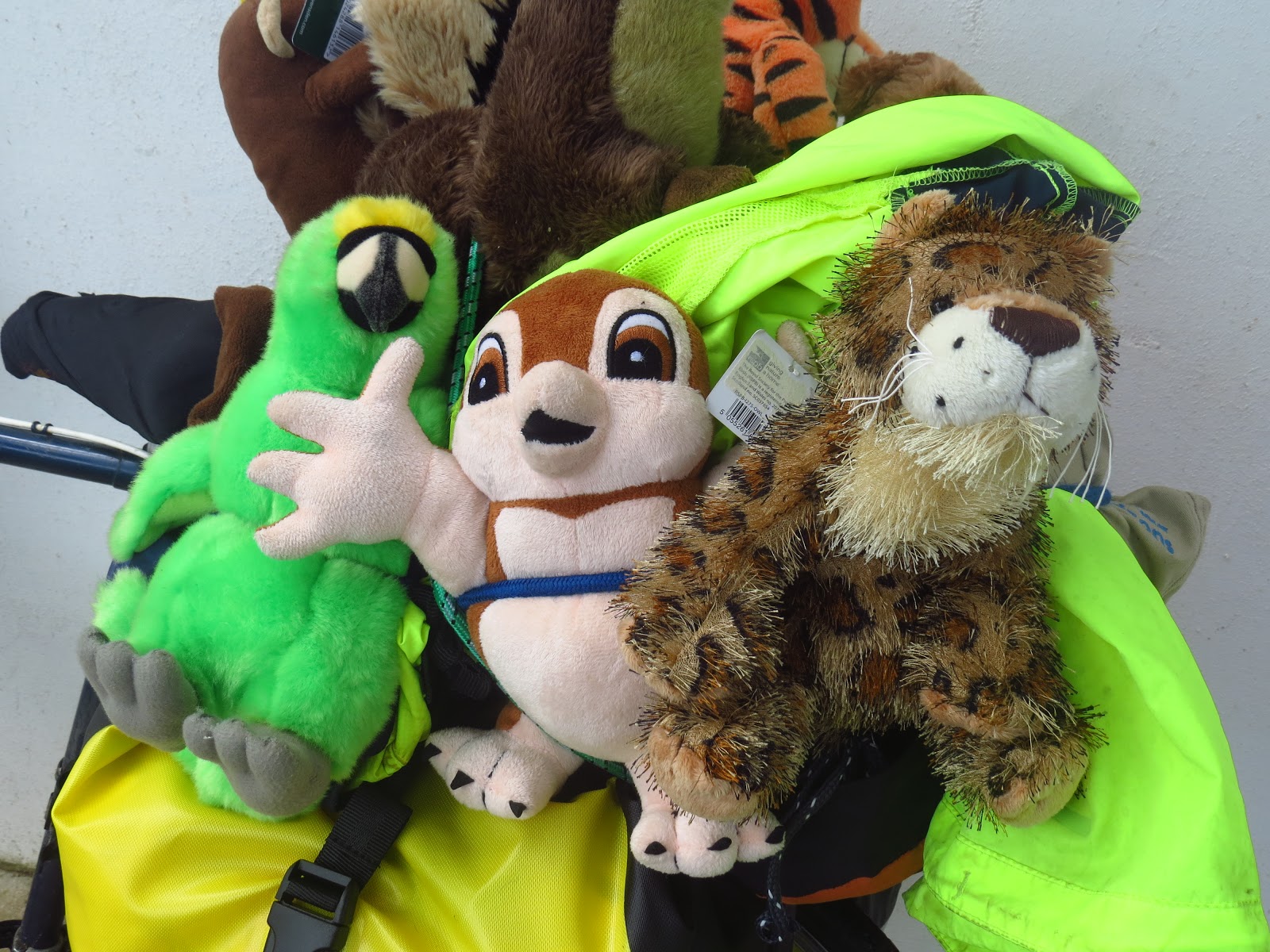
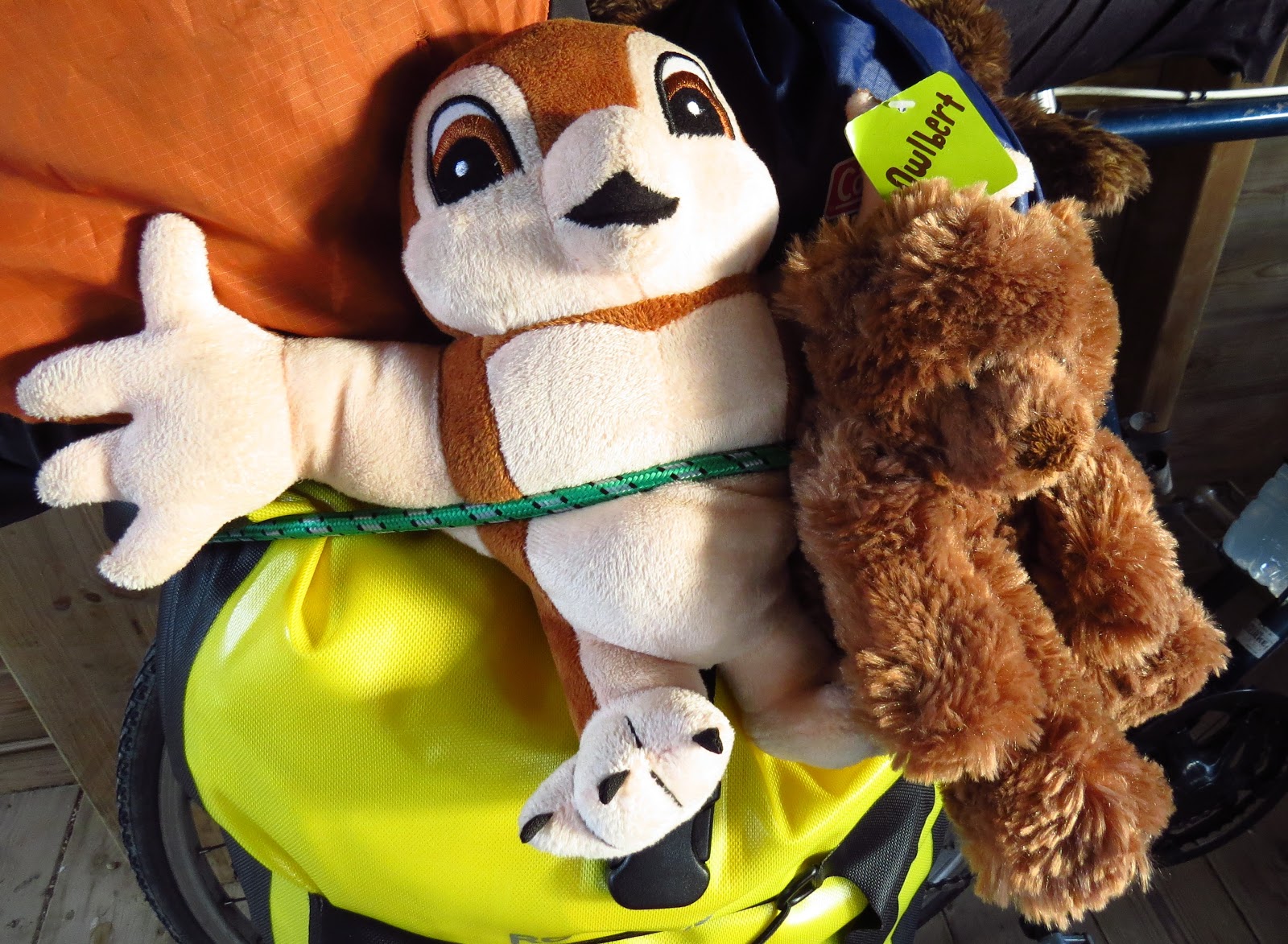
Off on the bike, now replete with this year's collection of cuddly toys as shown above, I stop by a roadside ditch to watch two migrating Wrynecks. Amazing how close you can get when sitting on a bike. They seem unperturbed by my presence.


I take the route that Ponc and I and the electric biking others took last night and, after a stop to watch the masses of migrating Sand Martins sitting in their hundreds on a large expanse of dried mud by a long beach, sleep in the northern-most bird hide. Two couples come in as I sit and enjoy the setting sun and the passing masses of Greater Flamingoes and Glossy Ibis. One of the couples, had just talked to Magda about coming out to Peru in order to make a film about Chontachaka! As we chatted there is suddenly a very loud humming noise and on looking out of the hide, we could see that the marshes were covered with clouds of billions of Mosquitos. This lasts for around thirty minutes or si and just as suddenly as it started the noise stops and the Mosquitos have gone.


Monday 23rd September


Up early, everything packed into the panniers, I set off north across the agricultural areas of the Delta. Stopping every time there are birds, my progress is slow but very enjoyable. Over the large River Ebro and through a couple of towns, , I stop to watch and count a newly arrived flock of twenty nine White Storks.


L'Ampollo is extremely hot and after shopping for some food I head off along a beautifully surfaced tarmac dual carriageway reaching El Perello by late afternoon and tonight's accommodation, Hostel


Tuesday 24th September

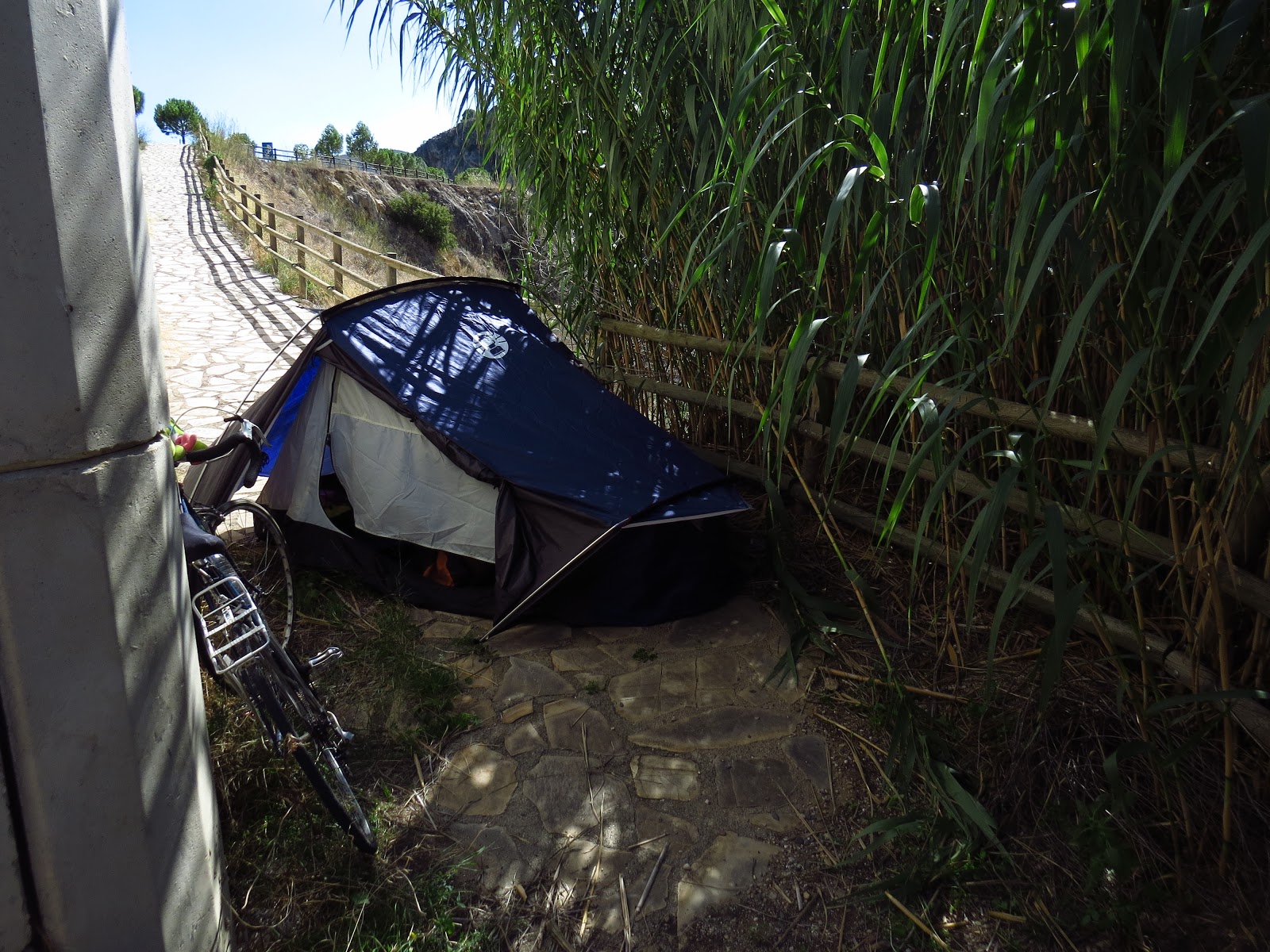
Early start, around 8.00 am, in order to avoid most of the heat of the day, I push the bike up the initial hills and cycle towards Here the roads joins the and as the day gets increasingly hotter, a strong breeze begins into my face, reminiscent of The Mistral of the Rhone in France, only this time the wind is coming down the River Ebro. Exhausting as it is cycling into the wind with such a heavy bike, I find mid afternoon a layby which has a path and tunnel that goes beneath the busy road. In the shade with the breeze coming over me I lay down and sleep the heat away. Eventually I put my tent up here and sleep the night away.


46.2 kilometres 269 metres up 372 metres down

Wednesday 25th September

Early morning cycling gets me to a cafe for coffee and a chat with a young twenty-two year old Spaniard, Nathan, whose passion in life is making money via 'four currencies.' Nathan says that Brexit is great for his business as he makes money when Sterling goes down.


Today I feel great as at last my hands don't feel painful and the more obvious cycling related painful area is less painful than on the previous days. I always tend to totally forget the pain that starting Biking Birder adventures brings for the first few days. Focusing on the positives is a far better thing to do.

A huge area of desolation and burnt trees, I cycle through and wonder how long ago the forest fire was. On one side of the road green Pine trees grow, on the other side of the road charcoaled stumps, the road had acted as a break in the fire's progress.


Two in the afternoon and I arrive at a village called Maials. The only lady walking around is an English teacher and she takes me to a restaurant that has rooms. The restaurant is very busy and so I head off to explore the village. Finding a cool stone bench under an ancient archway, I sleep my siesta for an hour or two.


30.3 kilometres 475 metres up 176 metres down

Thursday 26th September

A dirt road away from the village is quiet and dusty. Lots of Larks, lots of finches and the occasional Wheatear, I stop to record a short video about my progress just as three foxes cross the road emerging from bushes to my left. Another fox crosses the track some way downhill from where I am standing.


Landscape changes from Pine forest to open sierra stripped of this year's crops and eventually down to the riverside where huge peach orchards stand. I stop and snack whilst watching the waters of the River Ebro from a bridge. Great White Egrets pass, as does a lone Kingfisher. A few very large Carp push through weeds muddying the waters.


Into Lleida, a large cosmopolitan city to find my hostel for the night. An extra payment of 50p as tourist tax is a surprise.

Friday 27th September

Routine now established, up early whilst still dark, pack bike and get on the road by 8. Cycle and bird the morning away and then find accommodation to get out of the afternoon heat.


The road west towards Huesca, the N-240, is very busy and I soon grateful to find an almost empty country road that goes through various villages and farmland. The first village is more like a New Town with 'little boxes built of ticky tacky', as the house and apartments all look the same. I am perturbed to see a large sculpture outside a Primary school that seems to suggest that boys have greater thoughts than girls.


Up a steep hill onto a plain with massed blocks of maize, a tractor is being followed by Cattle Egrets as a few White Storks stand Together some way off.


Back onto the now quieter N-240 I am stopped in my tracks by the disgusting site of a large industrial scale cow suffering farmyard. This obscenity has hundreds of cows straining their heads through grills to access what constitutes here as food, a dry-looking pale green dust like material. The only place for the cows to go other than these grills are small square, dark soiled squares with nothing like grass, just dirt. As if this wasn't horrible enough, a little further along this monstrocity there were dozens of plastic shelters with small two metre square paddocks for calves to individually live in. Any advert that shows cows feeding in grassy meadows should be made to show this sort of reality if the product being sold is created here. I cry at the sight. No animal should be treated thus!


My mood had been carefree and happy. Now I am distraught and full of the negative thoughts that can overwhelm one with Climate Destruction imminent and the politics of the day being more right-wing with every passing moment. I try to sing to dispel these thoughts and deflect towards a more positive attitude.

Twenty kilometres or so later, whilst cycling fast downhill, an exploding back tyre is a major problem. In two years of cyclinga round the UK I only had two punctures. In Peru last year I didn;t have any! On examining the trye wall, I find that it is ripped. No repair possible, I start to push towards Monzon, a city about ten kilometres away.

The preferred hostel is reached and the owner tells me that there is a cycle shop called Dr Bike in the city. At 5 o'clock I take the whole bike down there and Oscar, the owner gives me a wheel with a new tyre for free!

Saturday 28th September

Goodbye to this superb hostel, I cycle down towards the city of Monzon and BANG! The new tyre has blow out and the shop is closed for the weekend. What to do? With no record at stake this time on this Biking Birder adventure, I make my way to the city's railway station, intending to get to Huesca in the hope that a cycle shop there will be open and have the necessary wheel and tyre. No train to Huesca, I get a train to Zaragoza instead.

No accommodation available in Zaragoza, I get a train to Logrono. Two hours of dry Spanish countryside, I listen to Pink Floyd's Learning to Fly song and change the words in my head to suit today's problems.

Into this distance on this ribbon of black
No back tyre and no turning back
This ride of fancy
on this desert plain
Standing alone with problems again
Fatal inaction is stopping my Green
How can I escape from what should be foreseen
Can't keep my mind from this moment's desire
A problem solved by a new tyre

[soaring guitar solo]


Saturday, 28 September 2019

A new adventure starts at The Ebro Delta Birding Festival, Spain


A new Biking Birder Adventure from The Ebro Delta in Northern Spain, cycling through Catalonia and Aragon before crossing The Pyrenees into France, all in aid of raising money for BIRDLIFE INTERNATIONAL.

Please make a donation via the JUST GIVING link attached to the BIRDLIFE INTERNATIONAL logo to the right. Thanks to all who do and I hope you enjoy reading about this latest adventure Biking Birder Adventure V.


Thursday 19th September

The Ebro Delta Bird Festival

After choosing the Green way to get to the Festival, that is to not use air travel and instead the comfort of two days and nights either on trains or coaches via Paris and Barcelona, 


I arrived at the hotel and birded around the area. Flamingoes, Squacco Herons, Yellow-legged Gulls, Hoopoes and Yellow Wagtails, just a short couple of kilometres walked before returning to the hotel and meeting up with some of the other speakers, for that is what I am doing here. I am going to be one of the speakers at The Festival and, at last, I am going to meet the other great Green Birding champion, Ponc Feliu Latorre. Ponc is the 'purest' Green Birding European Champion having seen 304 birds by cycling. I personally was a 'dirty' Green Birder in my BIGBY, Big Green Big Year, as I used some ferries to get to the Scottish Islands of most Hebridean Islands, The Orkneys and Shetland and, of course, Fair Isle. That was in 2016, Biking Birder Adventure III, when I saw 318 species of bird.

Three days to enjoy this wonderful Birding festival, tomorrow we, the guest speakers, are to be taken into areas of the Delta where the public cannot access. Can't wait!

Details on the Festival, the guest speakers and activities can be found on The Delta Bird Festival website :-


Friday 20th September A Birding Safari at The Ebro Delta


Best way to detail the day is by showing the photographs. A wonderful day of birds, beautiful landscapes, heat and great company.


Tuesday, 30 April 2019

Climate Destruction is imminent.

What do we need to do?

Watch David Attenborough's latest programme . . .


Right, please post any thoughts in the comments below or go to my Facebook page . . .

Gary Brian Prescott

https://www.facebook.com/gary.prescott.92

Please message me, make comments, share your feelings.


Maybe you read Greta Thunberg's words from my previous blog posting.

What are you thoughts?


So, please watch David's video, read Greta's words and then PLEASE listen to Rupert Read's lecture . . . 


So?


Sunday, 28 April 2019

April 28th 2019 GRETA THUNBERG AND Extinction Rebellion

Here is a speech by the amazing Great Thunberg, given to the British Members of Parliament in the House of Commons . . . 


My name is Greta Thunberg. I am 16 years old. I come from Sweden. And I speak on behalf of future generations.
I know many of you don’t want to listen to us – you say we are just children. But we’re only repeating the message of the united climate science.
Many of you appear concerned that we are wasting valuable lesson time, but I assure you we will go back to school the moment you start listening to science and give us a future. Is that really too much to ask?
In the year 2030 I will be 26 years old. My little sister Beata will be 23. Just like many of your own children or grandchildren. That is a great age, we have been told. When you have all of your life ahead of you. But I am not so sure it will be that great for us.
I was fortunate to be born in a time and place where everyone told us to dream big; I could become whatever I wanted to. I could live wherever I wanted to. People like me had everything we needed and more. Things our grandparents could not even dream of. We had everything we could ever wish for and yet now we may have nothing.
Now we probably don’t even have a future any more.
Because that future was sold so that a small number of people could make unimaginable amounts of money. It was stolen from us every time you said that the sky was the limit, and that you only live once.
You lied to us. You gave us false hope. You told us that the future was something to look forward to. And the saddest thing is that most children are not even aware of the fate that awaits us. We will not understand it until it’s too late. And yet we are the lucky ones. Those who will be affected the hardest are already suffering the consequences. But their voices are not heard.
Is my microphone on? Can you hear me?
Around the year 2030, 10 years 252 days and 10 hours away from now, we will be in a position where we set off an irreversible chain reaction beyond human control, that will most likely lead to the end of our civilisation as we know it. That is unless in that time, permanent and unprecedented changes in all aspects of society have taken place, including a reduction of CO2 emissions by at least 50%.
And please note that these calculations are depending on inventions that have not yet been invented at scale, inventions that are supposed to clear the atmosphere of astronomical amounts of carbon dioxide.
Furthermore, these calculations do not include unforeseen tipping points and feedback loops like the extremely powerful methane gas escaping from rapidly thawing arctic permafrost.
Nor do these scientific calculations include already locked-in warming hidden by toxic air pollution. Nor the aspect of equity – or climate justice – clearly stated throughout the Paris agreement, which is absolutely necessary to make it work on a global scale.
We must also bear in mind that these are just calculations. Estimations. That means that these “points of no return” may occur a bit sooner or later than 2030. No one can know for sure. We can, however, be certain that they will occur approximately in these timeframes, because these calculations are not opinions or wild guesses.
These projections are backed up by scientific facts, concluded by all nations through the IPCC. Nearly every single major national scientific body around the world unreservedly supports the work and findings of the IPCC.
Did you hear what I just said? Is my English OK? Is the microphone on? Because I’m beginning to wonder.
During the last six months I have travelled around Europe for hundreds of hours in trains, electric cars and buses, repeating these life-changing words over and over again. But no one seems to be talking about it, and nothing has changed. In fact, the emissions are still rising.
When I have been travelling around to speak in different countries, I am always offered help to write about the specific climate policies in specific countries. But that is not really necessary. Because the basic problem is the same everywhere. And the basic problem is that basically nothing is being done to halt – or even slow – climate and ecological breakdown, despite all the beautiful words and promises.
The UK is, however, very special. Not only for its mind-blowing historical carbon debt, but also for its current, very creative, carbon accounting.
Since 1990 the UK has achieved a 37% reduction of its territorial CO2 emissions, according to the Global Carbon Project. And that does sound very impressive. But these numbers do not include emissions from aviation, shipping and those associated with imports and exports. If these numbers are included the reduction is around 10% since 1990 – or an an average of 0.4% a year, according to Tyndall Manchester.

And the main reason for this reduction is not a consequence of climate policies, but rather a 2001 EU directive on air quality that essentially forced the UK to close down its very old and extremely dirty coal power plants and replace them with less dirty gas power stations. And switching from one disastrous energy source to a slightly less disastrous one will of course result in a lowering of emissions.
But perhaps the most dangerous misconception about the climate crisis is that we have to “lower” our emissions. Because that is far from enough. Our emissions have to stop if we are to stay below 1.5-2C of warming. The “lowering of emissions” is of course necessary but it is only the beginning of a fast process that must lead to a stop within a couple of decades, or less. And by “stop” I mean net zero – and then quickly on to negative figures. That rules out most of today’s politics.
The fact that we are speaking of “lowering” instead of “stopping” emissions is perhaps the greatest force behind the continuing business as usual. The UK’s active current support of new exploitation of fossil fuels – for example, the UK shale gas fracking industry, the expansion of its North Sea oil and gas fields, the expansion of airports as well as the planning permission for a brand new coal mine – is beyond absurd.
This ongoing irresponsible behaviour will no doubt be remembered in history as one of the greatest failures of humankind.
People always tell me and the other millions of school strikers that we should be proud of ourselves for what we have accomplished. But the only thing that we need to look at is the emission curve. And I’m sorry, but it’s still rising. That curve is the only thing we should look at.
Every time we make a decision we should ask ourselves; how will this decision affect that curve? We should no longer measure our wealth and success in the graph that shows economic growth, but in the curve that shows the emissions of greenhouse gases. We should no longer only ask: “Have we got enough money to go through with this?” but also: “Have we got enough of the carbon budget to spare to go through with this?” That should and must become the centre of our new currency.
Many people say that we don’t have any solutions to the climate crisis. And they are right. Because how could we? How do you “solve” the greatest crisis that humanity has ever faced? How do you “solve” a war? How do you “solve” going to the moon for the first time? How do you “solve” inventing new inventions?
The climate crisis is both the easiest and the hardest issue we have ever faced. The easiest because we know what we must do. We must stop the emissions of greenhouse gases. The hardest because our current economics are still totally dependent on burning fossil fuels, and thereby destroying ecosystems in order to create everlasting economic growth.
“So, exactly how do we solve that?” you ask us – the schoolchildren striking for the climate.
And we say: “No one knows for sure. But we have to stop burning fossil fuels and restore nature and many other things that we may not have quite figured out yet.”
Then you say: “That’s not an answer!”
So we say: “We have to start treating the crisis like a crisis – and act even if we don’t have all the solutions.”
“That’s still not an answer,” you say.
Then we start talking about circular economy and rewilding nature and the need for a just transition. Then you don’t understand what we are talking about.
We say that all those solutions needed are not known to anyone and therefore we must unite behind the science and find them together along the way. But you do not listen to that. Because those answers are for solving a crisis that most of you don’t even fully understand. Or don’t want to understand.
You don’t listen to the science because you are only interested in solutions that will enable you to carry on like before. Like now. And those answers don’t exist any more. Because you did not act in time.
Avoiding climate breakdown will require cathedral thinking. We must lay the foundation while we may not know exactly how to build the ceiling.
Sometimes we just simply have to find a way. The moment we decide to fulfil something, we can do anything. And I’m sure that the moment we start behaving as if we were in an emergency, we can avoid climate and ecological catastrophe. Humans are very adaptable: we can still fix this. But the opportunity to do so will not last for long. We must start today. We have no more excuses.
We children are not sacrificing our education and our childhood for you to tell us what you consider is politically possible in the society that you have created. We have not taken to the streets for you to take selfies with us, and tell us that you really admire what we do.
We children are doing this to wake the adults up. We children are doing this for you to put your differences aside and start acting as you would in a crisis. We children are doing this because we want our hopes and dreams back.

Wednesday, 17 April 2019

Bking Birder IV - Peru 2018 Part 2 - May


Article written detailing my Peruvian Biking Birder adventure of 2018 - part 2 May


Birding in Peru, could it be simpler? Well since the last time you heard from me, my choice of bicycle and packraft, kayak to you and me, as my means of travel, have made life anything but easy. I may choose to Go Green but it has definitely made the challenge harder and maybe more worthwhile!


May has been all downhill, literally with the daily elevation figures showing that descent outdid the ascent figures, unlike in April and the scenery has been spectacular and in many places unexpected. One incident I didn't report to you, that occurred in April, may be of note for any naïve traveller. One fine morning I was leaving the small, high altitude village of Huanza by pushing the laden bike along a small rocky track. 


I was hoping that this track, just about wide enough to allow passage for a donkey or a Biking Birder with bike, would lead the road deep down in the claustrophobic valley and save a round trip of a few kilometres. The fact that it eventually did may not make up for the fact that I was lucky to escape with my life because of a huge angry mound of beefsteak that attacked, luckily, the bike. A bull, an immense brown and horned bull, came out of close by dense bushes and hit the front of the bike, knocking both me and the bike backwards a couple of metres! The bike landed on me and as the bull continued his attack I was trapped underneath it. The next few seconds may be a blur but the fact that I survived was due to two things. The bull was fixated on destroying the back panniers, one of which got stuck on one of his horns. The other thing that saved me was the arrival of two Peruvian men, who could see the commotion and came running. Their distraction of the beast allowed me to crawl from beneath the bike and make my escape by jumping into the bushes. An hour later I was back to pushing the bike uphill on the dirt track, rocky road, watching birds once more and trying to forget that the bull's head had been inches from mine. My left arm, which had been hit by one of the bulls horns, was badly bruised and extremely sore. My coat had a huge rip from his other horn but at least I was back birding. Expect the unexpected!


May started with a long day of cycling and pushing as I made my way away from the wonderful lagoon at Marcapomacocha. Shallow lagoons with Chilean Flamingos and various species of duck distracted the birder in me and one small pool with a dozen or some of the former also had a surprise when a Solitary Sandpiper appeared within the poolside vegetation. Later trying to photograph flushed Puna Snipe proved a challenge beyond me, as did photographing a flying Ornate Tinamou. Two Aplomado Falcons proved easier as they perched on top of telegraph poles and eyed me as I passed. Camping that night was a cold experience, as was shaking off the ice from the tent in the morning!


Up and over once more, the landscape, with views of snow-capped mountains all around me, spread out before me with grasslands dominated by three Llama species. The two domestic varieties, Llama and Alpaca were in herds sometimes approaching a hundred in number. The size of Llamas, such large long-necked camel like creatures and the combination of colours with whites, browns and creams, made passing them an exciting pleasure. The smaller Alpacas were usually white. The third species were wild and on my approach an alert male would emit a strange warbling alarm call, Vicunias. Delicate, warm buff-coloured and small, Vicunias would be in groups of half a dozen or so and would watch me carefully as I would cycle past. The two days of cycling through their land gave me so many opportunities to stop and appreciate the beauty of these wonderful sensitive animals.


A road, a busy tarmac road appeared like a heaven sent apparition in front of me one day. After weeks of dirt track, after weeks of uncyclable rocky pathways a tarmac road and even better, it went downhill. Twenty two miles of fast cycling descent, through limestone gorges that in Europe would be a major tourist attraction but here was just another route, led me to the first city, La Oroya. The steep sided, stunningly beautiful scenery led me south to Juanza and and then Huancayo, large cities, noisy, dusty and busy.
The contrast of the next week's cycling was marked. White-collared Swifts, large impressive fast flying swifts, maybe my favourite family of birds, had made their way onto the Green Year list, bird number 185 but additions to that list would be irregular and few. I knew they would be. I had entered a phase where distance travelled was important. I needed to get across to the next area where large numbers of birds were to be seen. I need to get to Machu Picchu, another four hundred miles away.
South of Huancayo the road eventually followed a beautiful river, the Mortago River. The road had a thin veneer of tarmac that was potholed and in places the tarmac had completely disappeared, leaving a very dusty, bumpy rocky surface to negotiate. There were new birds to see and hear. Streaked Tit-spinetails, White-bellied Hummingbirds, White-winged Black Tyrants, Black-backed Grosbeaks and Blue-capped Tanagers made notebook writing expansive with such names but at least they expanded the Green Year list. The further south the road went the drier and dustier it became. Thunderstorms on one afternoon left their mark as I negotiated muddy slurries where flash floods had brought down masses of material covering the road. One coach driver had made the mistake of trying to drive over a large area of such stuff and paid with his life. I sadly passed the upside down wreck of the coach the day after the accident. It had fallen hundreds of feet to the river below and lay smashed in the turbulent water.
The valley in places had alluvial plains where avocado orchards dominated and here flocks of parakeets of two species were seen but more often heard. Scarlet-faced and Mitred Parakeets were listed and photographed. Flocks of up to fifty birds noisily flew overhead but trying to see them when they were feeding or preening in the thick foliage of tall trees was difficult. Passerines became fewer with each passing miles and so two Red-eyed Vireos and a single Bran-coloured Flycatcher were appreciated.


Thunderstorms one day meant that the road was difficult to pass along as numerous mudslides covered it. One mudslide claimed the life of a coach driver. I came across the wreck of a new looking yellow coach, upside down in a large, white water river. The day before, during the storms, the driver had come across a large mudslide and decided to try and get across it. He had told the passengers to get off and attempted to do so with fatal consequences.
At Mayocc the long, deep river valley stretched out into a cowboy film landscape of tall cacti covered hills and mudstone erosions that made the area look like a small version of Monument Valley! Birds became very sparse. Occasional American kestrels on telegraph wires, small compared to our own Common Kestrel, behaved similarly in watching for a meal. White-winged Black Tyrants used tall cacti plants for their lookout perches. A Cinereous Harrier used a cliff face.
The large and beautiful city of Ayacucho was visited over a festival weekend. Festivities were enjoyed and the small problem of buying a pair of new boots was sorted. My last boots had worn away so badly because of the nature of the Andean roads that the soles had worn right off and I had had to put a thick wadding of cardboard inside each boot to protect my feet! Getting boots of a large enough size proved a problem. Peruvians are small people and size 11 boots are not available. A hot shower, something unavailable in the village hostels, meant that a promise to my mother back in Worcestershire, to shave my growing beard was kept.


The shoes caused major problems over the next few days with blisters and a bad cut on the toe joint of my right foot. Antiseptic creams and plasters, cotton wool wadding and cutting away sections of the front of the shoe, just as fast bowling cricketers do, allowed me to walk a little. In Chincheros and Uripa I could only walk a few miles each day as my feet were so painful. That aside though I did manage to see some new birds for the Green Birding Year list. A slow walk up a very steep hillside, past a large white statue of the Virgin Mary and child, found me sitting on a log staring down into a beautiful valley covered with natural tree and bush species, unlike the usual forest of Australian Eucalyptus. Eucalyptus is everywhere in The Andes due to it being such good firewood! As I sat there a number of new birds passed through. Two hummingbird species came close; Black-tailed Trainbearer and Green Violetear. Red-crested Cotinga was new, as was the fabulous looking Crimson-mantled Woodpecker. Walking slowly down a flock came through the canopy containing a group of Rust & Yellow Tanagers.
Camping a few days later I sat against a rock admiring the spectacular views of snow-capped mountains and having Rufous-webbed Bush Tyrant and Rusty-fronted Canestero come close. The best though was the constant stream of raptors such as Variable Hawk and Black-breasted Buzzard Eagle go over. The final highlight of the camp was the pair of Aplomado Falcons that landed nearby and mated as the female perched on the top most branch of a nearby fir tree. The ice on the tent in the morning was a small price to pay for such avian delights.
May finished with a bird total of 204, only 24 birds this month but the priority was getting the distance towards Amazonia covered and the 598 miles cycled was crucial. Peak after peak was followed by plummeting cycle runs and the overall elevation chart for the month shows that I haven't been below six thousand feet all month and have been over thirteen thousand feet on five occasions and over fourteen thousand feet once. The average altitude at the end of each day of the month was eleven thousand, four hundred and twenty feet! A tough month of cycling, pushing and walking.
Four months to go, my route has taken along the Andean range so that I now approach the famous Machu Picchu and from there it will take me down the equally famous in birding terms, Manu Road. More adventures to come, more landscapes to take my breath away and best of all, more incredible birds to see.

If you would like to follow my cycling and birding adventures then please take a look at my blog at :-


If you would like to see the photographs of each day then please go to my Facebook page :


I would like to say that I am asking for donations to Birdlife International and I really would appreciate your support. Donations keeps my legs peddling and my arms lifting my Opticron binoculars. Links to Justgiving page can be found on the blog.
I am also supporting a wonderful project that enables indigenous children to get an education and therefore fight the destruction in their area. It is called Chaskwasi-Manu I would really appreciate it if you could donate something to help them. Once more the link can be found on my blog.

Thanks everybody. Isn't it wonderful where Brummie birders get to . . . and how?

Gary, The Biking Birder


  One month from today I will be sleeping in Kigali, Rwanda. Before I get there I have so much to do, including posting 15 videos detailing ...